
Post
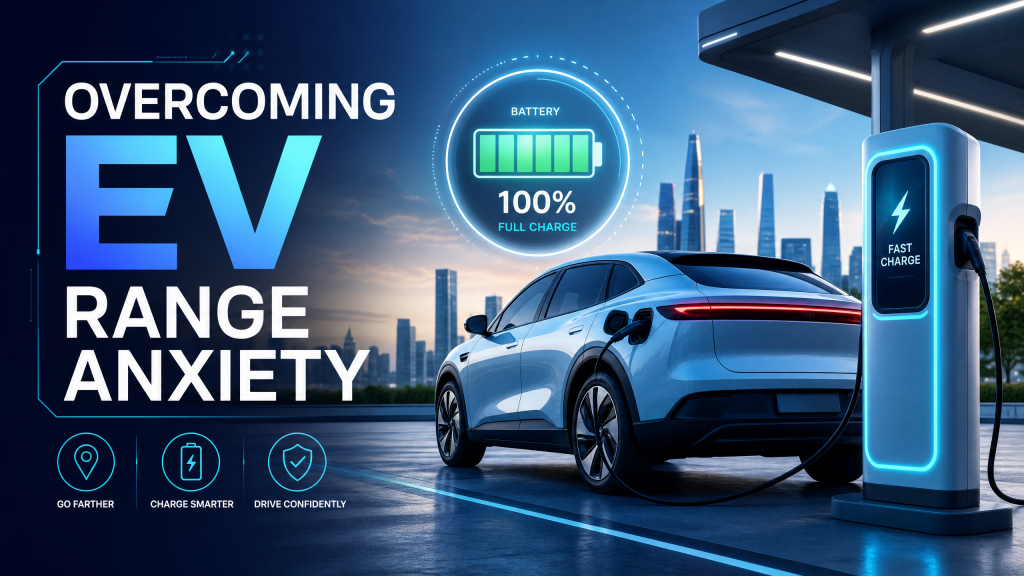
POST 12 – Electric Vehicle Range Anxiety: Myths, Realities, and How to Overcome It
Jun
Understanding EV Range Anxiety: Why Most Electric Vehicle Owners Stop Worrying About Range
Range anxiety has become one of the most discussed topics in the electric vehicle industry. For many potential buyers, the idea of running out of battery power before reaching a charging station remains the single biggest obstacle to purchasing an EV. Headlines frequently focus on charging infrastructure, battery limitations, and long-distance travel concerns, reinforcing the perception that electric vehicles are inconvenient compared to traditional gasoline-powered cars.
However, surveys consistently show something surprising: once people actually own an electric vehicle, range anxiety tends to disappear remarkably quickly. Most EV owners report that within a few weeks, they become comfortable with their vehicle’s capabilities and rarely think about range during daily driving.
The reality is that range anxiety is often more about unfamiliarity than actual limitations. Understanding how electric vehicles are used in everyday life, how charging works, and how modern EV technology manages energy consumption can help prospective buyers make informed decisions without unnecessary fear.
This guide explores the reality behind EV range anxiety, explains how modern electric vehicles perform in real-world conditions, and provides practical strategies for eliminating concerns about battery range altogether.
What Is Range Anxiety?
Range anxiety refers to the fear that an electric vehicle will run out of battery power before reaching a destination or charging station.
Unlike gasoline vehicles, where drivers can typically refuel within minutes at thousands of locations, electric vehicles require charging infrastructure and longer charging times. For individuals unfamiliar with EV ownership, this difference can seem intimidating.
Common concerns include:
- Running out of charge during a trip.
- Not finding a charging station when needed.
- Long charging times.
- Reduced range during cold weather.
- Battery degradation over time.
- Unexpected detours or traffic delays.
While these concerns are understandable, they often overestimate the challenges of real-world EV ownership.
The Reality: How Much Range Do Drivers Actually Need?
One of the biggest misconceptions surrounding electric vehicles is that drivers regularly need hundreds of miles of range every day.
According to transportation studies, the average American drives approximately 37 miles per day. Similar commuting patterns are observed in many countries worldwide.
Modern electric vehicles commonly offer:
- 200 miles of EPA-rated range.
- 250 miles of EPA-rated range.
- 300 miles of EPA-rated range.
- 350 miles or more in premium models.
Even a relatively modest EV with a 250-mile range can handle nearly a full week of average driving without needing a recharge.
Consider a driver who commutes 20 miles each way to work:
- Daily commute: 40 miles.
- Weekly commute: 200 miles.
- Vehicle range: 300 miles.
In this scenario, the vehicle easily covers daily transportation needs while maintaining a significant reserve.
This demonstrates why range anxiety is often driven by hypothetical worst-case scenarios rather than actual driving behavior.
The Home Charging Advantage
Perhaps the most transformative aspect of EV ownership is home charging.
Gasoline vehicle owners must periodically visit fuel stations. Electric vehicle owners can often charge at home while sleeping.
This fundamentally changes the ownership experience.
A Level 2 home charger typically operates on a 240-volt circuit and can add:
- 15 miles of range per hour.
- 20 miles of range per hour.
- 25 miles of range per hour.
- 30+ miles of range per hour depending on the vehicle.
For most households, charging overnight completely replenishes the energy used during the day.
Instead of asking:
“Where can I find a gas station?”
EV owners often ask:
“Did I plug in the car before bed?”
This convenience is one of the primary reasons many EV owners report higher satisfaction levels than traditional vehicle owners.
Understanding EPA Range Ratings
EPA range estimates provide a standardized method for comparing electric vehicles, but real-world driving conditions rarely match laboratory testing exactly.
Several factors influence actual range:
- Temperature.
- Driving speed.
- Wind conditions.
- Elevation changes.
- Passenger load.
- Cargo weight.
- Tire pressure.
- Climate control usage.
For example, a vehicle rated at 300 miles by the EPA may realistically achieve:
- 260–290 miles under favorable conditions.
- 240–260 miles during mixed driving.
- 180–220 miles in severe winter conditions.
Understanding these variations helps owners set realistic expectations and avoid unnecessary concern.
Cold Weather and Battery Performance
Cold temperatures represent one of the most significant challenges for electric vehicles.
Lithium-ion batteries rely on chemical reactions to store and deliver energy. As temperatures decrease, these reactions become less efficient.
Winter conditions can reduce range due to:
- Lower battery efficiency.
- Cabin heating requirements.
- Battery warming systems.
- Increased rolling resistance from snow-covered roads.
Some EVs may experience range reductions of 20 to 40 percent in extremely cold weather.
Fortunately, modern vehicles include advanced thermal management systems that help mitigate these effects.
Many EVs now feature heat pumps, which provide cabin heating far more efficiently than traditional electric resistance heaters.
Highway Driving and Energy Consumption
Another factor affecting range is vehicle speed.
At highway speeds, aerodynamic drag increases dramatically.
Unlike gasoline vehicles, where efficiency often improves at moderate highway speeds, EV efficiency can decline significantly when driving above 70 mph.
For example:
- Driving at 65 mph maximizes efficiency.
- Driving at 75 mph reduces range.
- Driving at 80+ mph can significantly increase energy consumption.
Drivers planning long road trips should account for these differences when estimating charging needs.
DC Fast Charging: Revolutionizing Long-Distance Travel
One of the biggest developments in EV adoption has been the rapid expansion of DC fast charging infrastructure.
Unlike home charging, DC fast chargers deliver high-power electricity directly to the battery.
Depending on the vehicle and charging station, DC fast charging can add:
- 100 miles of range in 20 minutes.
- 150 miles of range in 25 minutes.
- 200+ miles of range in 30 minutes.
Modern charging networks continue to expand rapidly across North America, Europe, and many parts of Asia.
Tesla’s Supercharger network remains the industry benchmark due to its:
- Large coverage area.
- High reliability.
- Fast charging speeds.
- Excellent integration with navigation systems.
Many Supercharger locations are now accessible to non-Tesla vehicles, significantly improving charging options for all EV owners.
Smart Navigation Systems Reduce Anxiety
Modern EVs include sophisticated route-planning software.
These systems automatically calculate:
- Battery consumption.
- Traffic conditions.
- Elevation changes.
- Weather effects.
- Charging station locations.
The vehicle can recommend optimal charging stops and estimate battery levels upon arrival.
This automation removes much of the uncertainty that previously accompanied long-distance EV travel.
Battery Pre-Conditioning: A Hidden Advantage
One feature unique to electric vehicles is battery and cabin pre-conditioning.
While connected to a charger, many EVs can:
- Warm the battery.
- Cool the battery.
- Heat the cabin.
- Defrost windows.
- Optimize charging performance.
Because the vehicle draws power directly from the charger rather than the battery, drivers start their trip with maximum available range.
This feature is particularly valuable during winter months when cabin heating would otherwise consume significant energy.
How Battery Degradation Actually Works
Many prospective buyers worry that battery degradation will dramatically reduce range over time.
Fortunately, real-world data suggests modern EV batteries are remarkably durable.
Most manufacturers provide battery warranties covering:
- 8 years.
- 100,000 miles.
- 70 percent minimum capacity retention.
Studies of high-mileage EVs often show battery capacity losses of only 10 to 15 percent after many years of ownership.
Battery technology continues to improve, further reducing long-term degradation concerns.
Practical Strategies to Eliminate Range Anxiety
New EV owners can take several simple steps to build confidence.
- Install a Level 2 charger at home.
- Charge regularly rather than waiting until the battery is nearly empty.
- Plan long trips using built-in navigation tools.
- Familiarize yourself with local charging networks.
- Keep charging apps installed on your smartphone.
- Understand seasonal range variations.
- Monitor tire pressure regularly.
These habits quickly become second nature and dramatically reduce concerns about range.
Why Most Range Anxiety Disappears
The most effective cure for range anxiety is experience.
After several weeks of ownership, drivers begin to understand:
- Their actual daily mileage needs.
- The availability of charging stations.
- The vehicle’s true range capabilities.
- How quickly charging fits into daily routines.
What initially seems like a major adjustment soon becomes normal.
Many EV owners eventually report the opposite phenomenon: they find it inconvenient to return to gasoline vehicles because they miss the convenience of home charging.
The Future of EV Range
Battery technology continues to advance rapidly.
Manufacturers are investing billions of dollars into:
- Higher energy-density batteries.
- Solid-state battery development.
- Faster charging systems.
- Expanded charging networks.
- Improved thermal management.
As these technologies mature, range anxiety is expected to become even less relevant for future EV buyers.
Conclusion
Range anxiety is understandable, but for most drivers it is largely a psychological concern rather than a practical limitation. Modern electric vehicles offer sufficient range for the vast majority of daily driving needs, and home charging fundamentally changes the ownership experience by eliminating frequent trips to fuel stations.
While factors such as weather, driving speed, and charging infrastructure still require consideration, today’s EVs are more capable than ever. Fast-charging networks continue to expand, navigation systems have become highly intelligent, and battery technology keeps improving.
For prospective EV buyers, the best advice may be the simplest: live with an electric vehicle for a few weeks before drawing conclusions. Like countless owners before them, most drivers discover that range anxiety fades quickly once real-world experience replaces hypothetical concerns.
