
Post
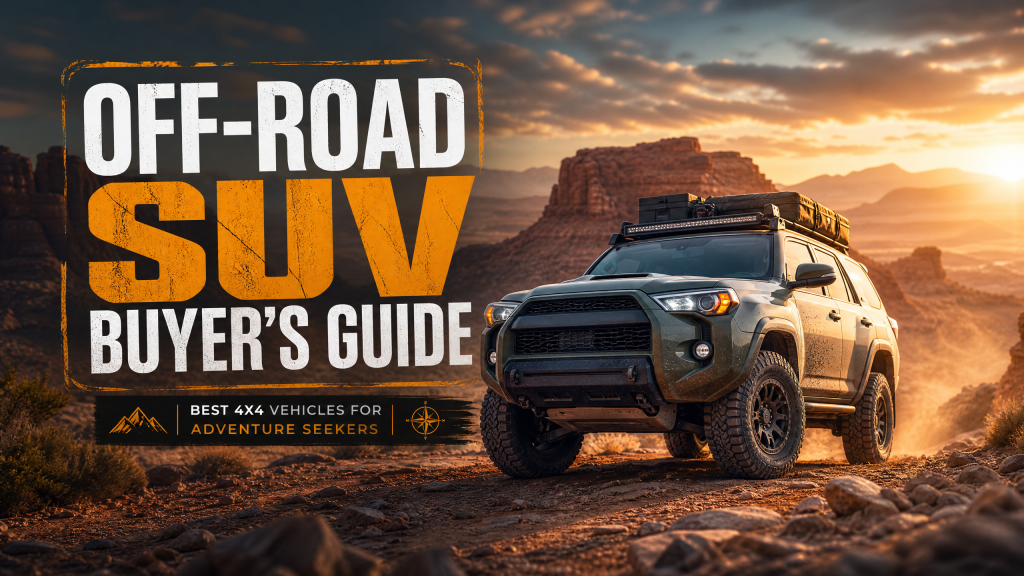
Off-Road SUV Buyer’s Guide: Best 4×4 Vehicles for Adventure Seekers
Jun
Off-Road SUV Buyer’s Guide: Best 4×4 Vehicles for Adventure Seekers
The market for capable off-road vehicles has never been stronger or more diverse, with manufacturers offering everything from mild all-wheel-drive crossovers to serious rock-crawling machines capable of tackling terrain that would stop most vehicles in their tracks. Understanding the spectrum of off-road capability — from light-duty all-weather SUVs to dedicated trail vehicles — is essential to matching the right vehicle to your actual adventure ambitions and budget. This comprehensive buyer’s guide examines the key technical factors and highlights the best options at different capability levels.
Understanding 4WD vs. AWD: What the Difference Actually Means
All-wheel drive (AWD) and four-wheel drive (4WD) are fundamentally different systems with different capability profiles that matter considerably when you venture beyond pavement. AWD systems operate automatically and continuously, sensing wheel slip and redistributing torque without driver input. They’re excellent for winter driving, rain-slicked roads, and light off-roading, but they’re not optimized for serious trail use. Traditional 4WD systems use locking hubs or a transfer case to create a mechanically locked connection between front and rear axles, providing maximum traction in challenging off-road conditions. The locked transfer case means both front and rear axles receive power regardless of traction conditions, crucial for technical terrain.
Additionally, most serious off-road vehicles offer a Low range in their transfer case — sometimes called 4-Lo — which provides dramatically reduced gear ratios for slow, controlled navigation over rocks, steep descents, or other technical obstacles. This crawler capability is unavailable in AWD systems and represents a fundamental capability advantage of properly equipped 4WD vehicles over their AWD counterparts.
Top Pick: Jeep Wrangler Rubicon
The Jeep Wrangler Rubicon remains the benchmark against which all other consumer off-road vehicles are measured, and the latest generation has improved comfort and technology while preserving its legendary capability. The Rubicon trim’s distinguishing features — electronic front and rear locking differentials, electronic disconnecting front sway bar, 33-inch all-terrain tires, and enhanced Dana axles — provide a level of factory off-road capability unmatched by any competitor in its price range. A Wrangler Rubicon can navigate technical trails that require significant modifications on other vehicles.
The body-on-frame construction provides the structural rigidity necessary for serious trail use, while the removable doors and roof satisfy the demand for open-air driving that is fundamental to the Wrangler’s character. The 4-cylinder turbocharged eTorque mild hybrid and V6 engine options provide adequate trail-use power, while the available 2.0-liter 4-cylinder turbo brings surprising efficiency for its class.
Toyota 4Runner TRD Pro
While not as extreme as the Wrangler Rubicon in outright rock-crawling capability, the Toyota 4Runner TRD Pro combines genuine off-road performance with everyday usability and Toyota’s legendary reliability record. The TRD Pro’s Fox Internal Bypass shocks provide 30% more suspension travel than standard models, allowing the 4Runner to navigate rough trails at higher speeds without bottoming out. Multi-Terrain Select allows the driver to choose traction modes optimized for specific surfaces including mud and sand, rock and dirt, moguls, and loose rock.
The 4Runner’s body-on-frame construction and solid rear axle give it genuine off-road credentials, while its Toyota reliability reputation means it’s far less likely to experience a mechanical failure in remote locations than many competitors. The 4Runner’s relatively unchanged core design — it’s based on an older platform than many competitors — has paradoxically become an asset, as decades of refinement have worked out any remaining engineering issues and a vast ecosystem of aftermarket parts has developed around the platform.
Ford Bronco Wildtrak and Raptor
Ford’s Bronco relaunch has been one of the most successful automotive revival stories in recent memory, with the second-generation Bronco delivering on its heritage while incorporating modern engineering and technology. The Bronco’s removable doors and roof recall the Wrangler’s open-air appeal while adding engineering advantages like a rigid and precise suspension geometry that improves both on-road handling and trail performance. The Sasquatch Package’s 35-inch all-terrain tires, locking front and rear differentials, and high-clearance suspension make the Bronco an extremely capable trail vehicle from the factory.
The Bronco Raptor takes the formula even further, combining the Bronco’s trail capability with Ford’s Raptor off-road performance engineering. A 3.0-liter EcoBoost V6 producing 418 horsepower, 37-inch tires, and Watts Link rear suspension designed for high-speed desert running make the Bronco Raptor the most capable high-speed off-road vehicle available from a mainstream manufacturer at its price point.
Land Rover Defender 110
Land Rover’s revived Defender brings authentic off-road heritage into the contemporary era with modern technology and significantly improved on-road behavior compared to its predecessor. The Terrain Response 2 system automatically detects road conditions and adjusts the powertrain, brakes, and suspension to optimize performance, while the available Air Suspension allows ground clearance adjustment for varying terrain challenges. Wade sensing can identify water depth before you commit to river crossings, and the Defender’s 900mm wading depth specification exceeds virtually all competitors.
The Defender’s premium positioning — pricing starts around $60,000 and reaches well over $100,000 for fully optioned models — separates it from more accessible options, but the combination of genuine off-road capability with genuinely premium interior quality and technology makes it a compelling choice for buyers who want serious capability without sacrificing daily comfort.
Practical Considerations for Off-Road Buyers
When selecting an off-road vehicle, consider how the vehicle will be used the majority of the time. A serious rock crawler that’s genuinely difficult to live with daily is a poor choice for someone who needs a daily commuter that occasionally visits easy trails. Conversely, a comfortable AWD crossover is inappropriate for buyers who regularly venture onto challenging trails. The best off-road vehicle is one that’s appropriately capable for your actual ambitions while remaining comfortable and practical for all the other miles you’ll drive. Many experienced off-road enthusiasts recommend starting with a vehicle that’s more capable than you think you’ll need, as off-road adventures have a way of gradually becoming more ambitious over time.
Essential Recovery Gear and Safety Equipment
Any serious off-road adventure requires preparation beyond the vehicle itself. Recovery gear should always accompany off-road excursions, including a high-lift jack capable of lifting a lifted vehicle, a traction board set for soft surface recovery, a kinetic recovery rope for vehicle-to-vehicle pulls, and basic hand tools for roadside repairs. Communication devices, including a satellite communicator for areas without cell service, have become genuinely important safety equipment as adventures take drivers farther from help. Driving with a group whenever possible provides immediate assistance capability if a recovery situation arises.
Understanding your vehicle’s recovery points, proper use of recovery equipment, and the techniques for various recovery scenarios is as important as the equipment itself. Many four-wheel-drive clubs offer off-road driving clinics that teach these skills in controlled environments, dramatically improving both safety and capability in challenging terrain.
