
Post
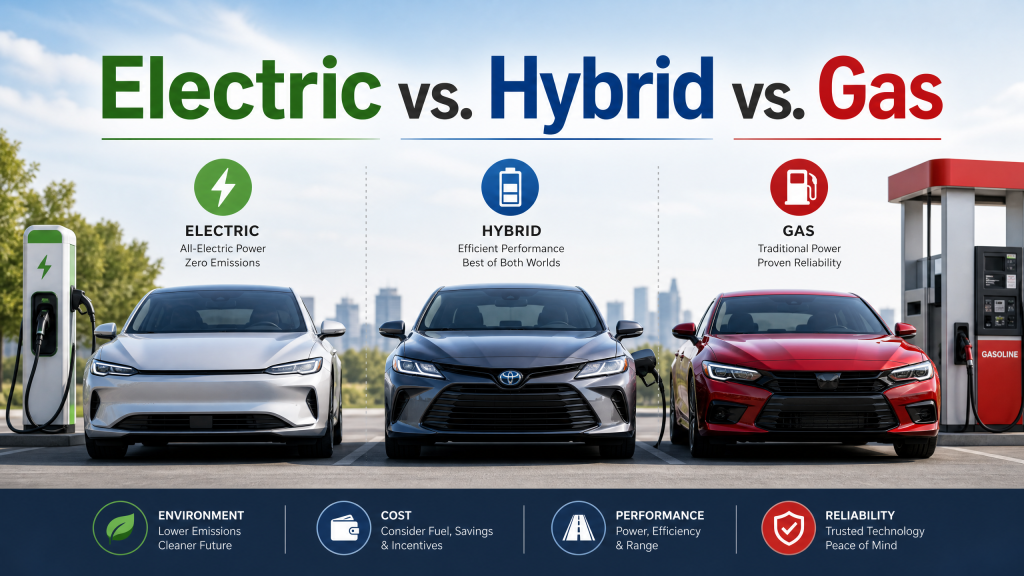
POST 03 – Electric vs. Hybrid vs. Gas: Which Vehicles Is Right for You?
Jun
Electric Vehicles vs Hybrids vs Gasoline Cars: Which Powertrain Is Right for You in 2025?
The automotive industry is undergoing one of the most significant transformations in its history. For more than a century, the internal combustion engine dominated personal transportation, but technological innovation, environmental concerns, government regulations, and changing consumer preferences have created an entirely new landscape. Today, car buyers are faced with more powertrain choices than ever before.
Instead of simply choosing between different brands, body styles, or performance levels, buyers must now decide how their vehicle will be powered. Should they embrace a fully electric vehicle (EV)? Is a plug-in hybrid (PHEV) the perfect compromise? Would a conventional hybrid (HEV) offer the ideal balance of efficiency and convenience? Or does a modern gasoline-powered vehicle still make the most sense?
Each option has unique strengths and weaknesses. The best choice depends on your daily driving habits, access to charging infrastructure, budget, lifestyle, and long-term ownership plans. Rather than asking which powertrain is objectively best, the more useful question is: which powertrain is best for your specific needs?
This guide examines the advantages, limitations, costs, and ideal use cases for battery-electric vehicles, plug-in hybrids, conventional hybrids, and traditional gasoline-powered cars to help you make an informed decision in 2025.
The Rise of Alternative Powertrains
The push toward alternative powertrains has been driven by several factors. Governments around the world have introduced stricter emissions regulations. Consumers have become increasingly aware of environmental issues and fuel costs. Meanwhile, advances in battery technology have dramatically improved vehicle range and performance.
Automakers have responded by investing billions of dollars into electrification. Nearly every major manufacturer now offers multiple hybrid, plug-in hybrid, or fully electric models. What was once considered niche technology has become mainstream.
However, despite the rapid growth of electric vehicles, gasoline-powered cars still represent the majority of vehicles on the road. The transition is happening gradually, creating a market where multiple technologies coexist and compete.
Battery-Electric Vehicles (BEVs)
Battery-electric vehicles, commonly known as EVs, operate entirely on electricity stored in large battery packs. Unlike conventional vehicles, EVs have no gasoline engine, fuel tank, exhaust system, or transmission in the traditional sense.
Popular examples include the Tesla Model 3, Hyundai Ioniq 5, Kia EV6, Ford Mustang Mach-E, Chevrolet Equinox EV, and BMW i4.
Advantages of EVs
One of the most attractive aspects of EV ownership is the driving experience. Electric motors deliver maximum torque instantly, resulting in rapid acceleration and smooth power delivery. Even relatively affordable EVs often outperform traditional gasoline vehicles in acceleration tests.
EVs also produce zero tailpipe emissions. While electricity generation may still involve fossil fuels in some regions, electric vehicles generally reduce overall carbon emissions compared to conventional cars.
Maintenance requirements are significantly lower because EVs contain far fewer moving parts. Owners do not need oil changes, spark plug replacements, fuel filter changes, or transmission servicing. Regenerative braking systems also reduce wear on brake components, extending brake pad life.
Charging at home is another major advantage. Instead of visiting gas stations, many EV owners simply plug in overnight and wake up with a fully charged vehicle each morning.
Challenges of EV Ownership
Despite their advantages, EVs are not perfect for every driver. Purchase prices remain higher than many comparable gasoline vehicles, although government incentives may offset some of the cost.
Charging infrastructure varies significantly by location. Urban areas and major highways often have extensive charging networks, while rural regions may offer limited options.
Long-distance travel requires more planning than gasoline vehicles. Even fast charging takes longer than filling a fuel tank, and charging station availability can sometimes be inconsistent.
Cold weather can also reduce battery efficiency and driving range, making climate an important consideration for some buyers.
Who Should Buy an EV?
EVs are often the best choice for drivers who:
- Have access to home charging.
- Drive less than 200 miles per day.
- Want lower maintenance costs.
- Prioritize environmental sustainability.
- Enjoy modern technology and performance.
Plug-In Hybrid Electric Vehicles (PHEVs)
Plug-in hybrid electric vehicles combine elements of both electric and gasoline-powered transportation. They feature a rechargeable battery pack and electric motor alongside a conventional internal combustion engine.
Most modern PHEVs offer between 20 and 50 miles of electric-only driving range before automatically switching to gasoline power.
Examples include the Toyota RAV4 Prime, Hyundai Tucson Plug-In Hybrid, Volvo XC60 Recharge, and BMW X5 xDrive50e.
Advantages of PHEVs
PHEVs provide flexibility that neither EVs nor traditional hybrids can fully match. For short daily commutes, drivers may use little or no gasoline. Yet unlike EVs, long-distance trips require no charging stops because the gasoline engine provides unlimited practical range.
For many households, daily driving falls comfortably within a PHEV’s electric range. This means owners can enjoy most of the benefits of EV ownership without concerns about charging infrastructure during vacations or road trips.
Fuel economy can be exceptionally high when drivers consistently charge the battery and maximize electric operation.
Challenges of PHEVs
The primary disadvantage of a PHEV is complexity. Essentially, the vehicle contains two complete propulsion systems: a battery-electric system and a gasoline drivetrain.
This increases manufacturing costs, vehicle weight, and long-term maintenance complexity. Purchase prices are often higher than both traditional hybrids and comparable gasoline vehicles.
The efficiency benefits also depend heavily on charging behavior. Drivers who rarely charge their PHEV may not realize meaningful fuel savings.
Who Should Buy a PHEV?
A plug-in hybrid may be ideal for drivers who:
- Have access to home or workplace charging.
- Commute relatively short distances daily.
- Frequently take long road trips.
- Want electric driving without range anxiety.
- Are comfortable managing both electricity and gasoline.
Conventional Hybrid Vehicles (HEVs)
Conventional hybrids use a smaller battery and electric motor to assist a gasoline engine. Unlike PHEVs, they cannot be plugged in and generally cannot travel significant distances on electricity alone.
Well-known examples include the Toyota Prius, Toyota Corolla Hybrid, Toyota Camry Hybrid, Honda Accord Hybrid, and Hyundai Elantra Hybrid.
Advantages of HEVs
The greatest advantage of a conventional hybrid is simplicity. Drivers do not need to alter their habits, install charging equipment, or learn new routines. Refueling occurs exactly as it does with any gasoline vehicle.
The hybrid system automatically improves efficiency by recovering energy during braking and assisting the engine during acceleration.
Many hybrids achieve fuel economy figures nearly double those of comparable non-hybrid vehicles, particularly in city driving conditions where regenerative braking provides maximum benefit.
Modern hybrid systems have proven remarkably reliable. Toyota, for example, has decades of real-world experience demonstrating the durability of hybrid technology.
Challenges of HEVs
While hybrids offer impressive efficiency gains, they do not eliminate gasoline consumption entirely. Drivers still rely on fuel stations and remain subject to fluctuating gasoline prices.
Performance improvements vary depending on the vehicle. Some hybrids prioritize efficiency over driving excitement, although this has improved significantly in recent years.
Hybrid vehicles also typically cost more than comparable gasoline models, though the premium is often recovered through fuel savings over time.
Who Should Buy a Hybrid?
Conventional hybrids are an excellent choice for drivers who:
- Want improved fuel economy.
- Do not have access to charging.
- Prefer familiar ownership experiences.
- Drive frequently in urban environments.
- Want lower operating costs with minimal lifestyle changes.
Traditional Gasoline Vehicles
Although electrification dominates industry headlines, modern gasoline-powered vehicles remain highly relevant. Today’s engines are cleaner, more efficient, and more sophisticated than ever before.
Technologies such as direct fuel injection, turbocharging, cylinder deactivation, variable valve timing, start-stop systems, and mild-hybrid assistance have significantly improved efficiency.
Advantages of Gasoline Cars
Gasoline vehicles remain the most affordable option in terms of initial purchase price. They also benefit from a mature refueling infrastructure that allows drivers to travel virtually anywhere without planning around charging stations.
Refueling takes only a few minutes, making long-distance travel exceptionally convenient.
Repair networks are extensive, and technicians are familiar with gasoline powertrains across all regions.
Challenges of Gasoline Cars
Compared to hybrids and EVs, gasoline vehicles generally have higher fuel costs and greater maintenance requirements. Regular oil changes, spark plug replacements, exhaust system repairs, and transmission servicing contribute to ongoing ownership expenses.
They also produce higher emissions than alternative powertrains and may face increasing regulatory pressure in some markets over the coming decade.
Who Should Buy a Gasoline Vehicle?
Gasoline-powered cars may still be the best choice for:
- Drivers with limited charging access.
- Rural residents.
- Frequent long-distance travelers.
- Budget-conscious buyers seeking lower upfront costs.
- Consumers who prioritize convenience and familiarity.
Total Cost of Ownership: Looking Beyond Purchase Price
One of the biggest mistakes buyers make is focusing solely on the sticker price. The true cost of vehicle ownership includes fuel, electricity, maintenance, insurance, depreciation, and financing costs.
EVs often carry higher upfront prices but significantly lower operating expenses. Electricity typically costs less per mile than gasoline, and maintenance expenses are substantially reduced.
Hybrids generally recover their price premium through fuel savings over several years, particularly for drivers with high annual mileage.
PHEVs occupy a middle ground, offering fuel savings but requiring a higher initial investment and potentially greater maintenance complexity.
Calculating total ownership costs over five to ten years provides a more accurate picture of long-term value than comparing purchase prices alone.
Conclusion: Choosing the Right Powertrain for Your Life
The modern automotive marketplace offers more powertrain choices than ever before, and each has legitimate advantages depending on individual circumstances.
If you have reliable charging access and primarily drive moderate distances, a battery-electric vehicle may provide the lowest operating costs and the most advanced driving experience. If you want electric capability without sacrificing long-distance flexibility, a plug-in hybrid can offer an attractive compromise.
For buyers seeking exceptional fuel efficiency without changing daily habits, conventional hybrids remain one of the smartest and most practical choices available. Meanwhile, modern gasoline vehicles continue to deliver affordability, convenience, and proven reliability for millions of drivers worldwide.
There is no universally perfect powertrain in 2025. The right choice depends on where you live, how you drive, your budget, and your personal priorities. By carefully evaluating your lifestyle and ownership goals, you can select the technology that delivers the greatest value and satisfaction for years to come.
