
Post
POST 14 – The Future of Autonomous Driving: Where Are We Really in 2025?
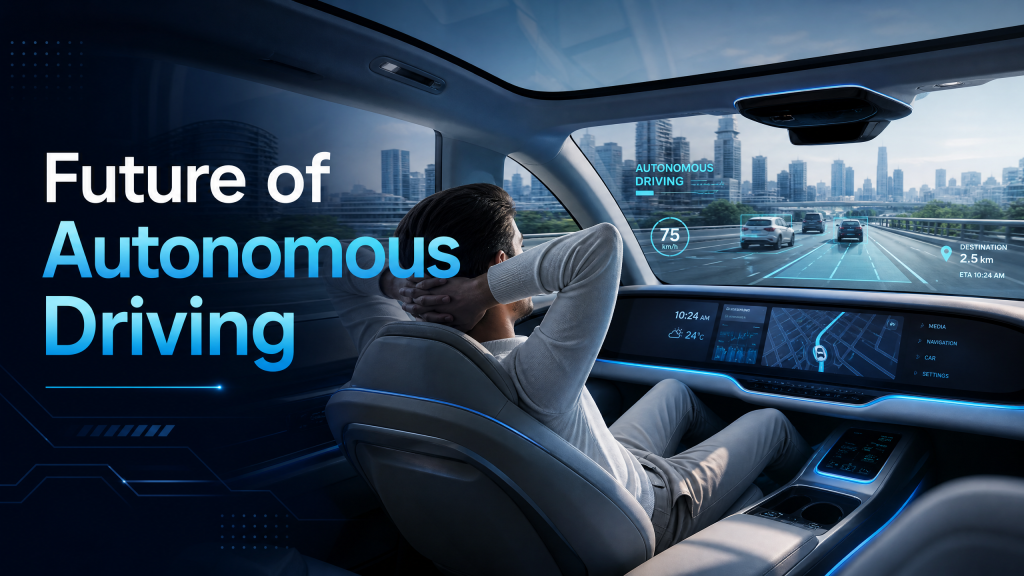
Jun
Autonomous Driving in 2025: How Close Are We to Self-Driving Cars?
For more than a decade, autonomous driving technology has been one of the most talked-about innovations in the automotive industry. Technology companies, automakers, and industry analysts have repeatedly predicted that fully self-driving cars were just a few years away. Yet despite enormous investments, countless test miles, and rapid advancements in artificial intelligence, truly autonomous vehicles remain relatively rare outside limited pilot programs and specialized commercial services.
This disconnect between expectation and reality has led many consumers to become skeptical of self-driving technology. Headlines promising driverless cars have often been followed by delays, regulatory challenges, and technical setbacks. However, focusing only on the industry’s unfulfilled predictions overlooks the remarkable progress that has actually occurred.
Modern driver-assistance systems available in 2025 are dramatically more capable than those found in vehicles just five years ago. Today’s technology can reduce driver fatigue, improve safety, assist with highway travel, and handle many routine driving tasks under specific conditions. While fully autonomous vehicles may still be years away from widespread adoption, the journey toward autonomy is already changing how people drive.
To understand where autonomous driving stands today—and where it may be heading—it is important to examine the different levels of automation, the capabilities of current systems, their limitations, and the realistic timeline for future development.
Understanding the SAE Levels of Driving Automation
The Society of Automotive Engineers (SAE) developed a standardized framework that classifies driving automation into six levels, ranging from Level 0 to Level 5. Understanding these levels helps clarify what today’s vehicles can actually do and what remains technologically challenging.
Level 0: No Automation
At Level 0, the driver performs all driving tasks. While warning systems such as blind-spot monitoring or forward-collision alerts may be present, they do not actively control the vehicle.
Level 1: Driver Assistance
Level 1 systems can assist with either steering or acceleration and braking, but not both simultaneously. Adaptive cruise control is a common example. The driver remains fully responsible for monitoring the road and controlling the vehicle.
Level 2: Partial Automation
Level 2 systems can simultaneously manage steering, acceleration, and braking under specific conditions. However, the driver must remain attentive at all times and be prepared to take over immediately if needed.
Popular Level 2 systems include:
- Tesla Autopilot
- Ford BlueCruise
- GM Super Cruise
- Mercedes Driver Assistance Package
- BMW Driving Assistant Professional
- Hyundai Highway Driving Assist
Most advanced consumer vehicles sold today fall into this category.
Level 3: Conditional Automation
Level 3 allows drivers to temporarily disengage their attention under certain conditions because the vehicle assumes responsibility for monitoring the driving environment. However, the driver must remain available to resume control when requested.
Several manufacturers are beginning limited Level 3 deployments in specific markets and highway environments.
Level 4: High Automation
Level 4 vehicles can operate completely autonomously within defined operating environments, often referred to as geofenced areas. Human intervention is generally not required while the vehicle remains within those designated zones.
Level 5: Full Automation
Level 5 represents complete autonomy under all road, traffic, and weather conditions. A Level 5 vehicle would not require a steering wheel, pedals, or human supervision.
No commercially available Level 5 vehicles currently exist.
How Far Have Level 2 Systems Advanced?
Although Level 5 autonomy continues to attract media attention, Level 2 technology has experienced some of the most meaningful real-world improvements in recent years.
Modern systems are far more sophisticated than earlier generations. Using a combination of cameras, radar sensors, ultrasonic sensors, GPS data, high-definition maps, and increasingly powerful onboard computers, today’s driver-assistance systems can perform tasks that would have seemed extraordinary a decade ago.
On well-marked highways, many Level 2 systems can:
- Maintain lane position.
- Adjust speed automatically.
- Navigate stop-and-go traffic.
- Change lanes with driver approval.
- Maintain safe following distances.
- Respond to traffic flow changes.
For drivers who spend significant time commuting or traveling on highways, these features can substantially reduce fatigue and improve comfort.
GM Super Cruise: A Leading Example
General Motors’ Super Cruise is often considered one of the most advanced consumer driver-assistance systems available today.
Unlike some competing technologies that rely primarily on cameras and onboard sensors, Super Cruise combines:
- High-definition LiDAR-generated road maps.
- GPS positioning.
- Radar sensors.
- Camera systems.
- Driver monitoring cameras.
The driver-monitoring component is particularly important. An infrared camera continuously tracks driver attention and ensures the driver remains engaged with the driving task.
This approach helps reduce the risk of misuse and improves overall system safety.
Many drivers report that Super Cruise performs exceptionally well on compatible highways, allowing extended periods of comfortable hands-free driving while maintaining strong safety oversight.
Ford BlueCruise and Mercedes Driver Assistance Systems
Ford’s BlueCruise has emerged as another strong competitor in the hands-free highway driving space. Available on several Ford and Lincoln vehicles, BlueCruise offers hands-free operation on designated highways throughout North America.
Similarly, Mercedes-Benz has invested heavily in advanced driver-assistance technology. Its systems provide smooth lane centering, adaptive cruise control, traffic jam assistance, and increasingly sophisticated automation capabilities.
Mercedes has also become one of the first manufacturers to achieve regulatory approval for certain Level 3 features in select markets, representing a significant milestone for the industry.
What Current Systems Do Well
Modern Level 2 systems excel under predictable driving conditions, particularly on divided highways with clear lane markings.
Common strengths include:
- Long-distance highway cruising.
- Traffic congestion assistance.
- Speed management.
- Lane centering.
- Driver fatigue reduction.
- Smoother vehicle operation.
For many drivers, these systems improve convenience and reduce the mental workload associated with repetitive highway driving.
Research also suggests that advanced driver-assistance systems can help reduce certain types of collisions by reacting more quickly than human drivers in specific scenarios.
Where Current Systems Still Struggle
Despite impressive progress, modern driver-assistance systems remain far from perfect.
Level 2 automation frequently struggles with situations that humans handle relatively easily.
Examples include:
- Construction zones.
- Temporary lane markings.
- Unmarked rural roads.
- Complex intersections.
- Sharp curves.
- Unexpected obstacles.
- Pedestrian unpredictability.
- Adverse weather conditions.
- Snow-covered roads.
- Heavy rain or fog.
The challenge stems from the fact that real-world driving environments are highly variable. Human drivers rely on context, judgment, and experience to interpret unusual situations, while automated systems must translate these complexities into machine-readable data.
Although artificial intelligence has improved dramatically, replicating human-level situational awareness remains extraordinarily difficult.
The Problem of Automation Complacency
One of the greatest safety challenges facing today’s driver-assistance systems is not necessarily technological failure—it is human behavior.
Many drivers overestimate the capabilities of their vehicles. Marketing terminology such as “Autopilot,” “Self-Driving,” or similar branding can create unrealistic expectations regarding system performance.
This can lead to automation complacency, where drivers become less attentive because they believe the vehicle is more capable than it actually is.
When a sudden intervention becomes necessary, inattentive drivers may not respond quickly enough.
For this reason, manufacturers increasingly incorporate driver-monitoring technologies that ensure drivers remain engaged while automation is active.
Robotaxis and the Rise of Level 4 Autonomy
While consumer vehicles remain largely limited to Level 2 functionality, robotaxi programs have achieved notable progress toward Level 4 autonomy.
Waymo, a subsidiary of Alphabet, currently operates one of the world’s most advanced autonomous ride-hailing services.
Waymo vehicles operate without human safety drivers in selected areas of:
- Phoenix, Arizona
- San Francisco, California
- Los Angeles, California
These services demonstrate genuine Level 4 autonomy because the vehicles can operate independently within designated geographic boundaries.
Passengers simply request rides through an app and travel without a human driver present.
Why Scaling Robotaxis Is Difficult
Although robotaxi deployments represent a significant achievement, expanding these systems nationwide presents enormous challenges.
Key obstacles include:
- Infrastructure variation.
- Weather differences.
- Regulatory requirements.
- Mapping complexity.
- Economic scalability.
- Operational costs.
- Public acceptance.
A system that performs well in a carefully mapped urban area may require substantial adaptation before operating safely across thousands of different cities and road networks.
The Emergence of Level 3 Systems
Level 3 automation represents the next major step for consumer vehicles.
Unlike Level 2 systems, Level 3 technology allows drivers to temporarily disengage their attention under specific conditions because the vehicle assumes responsibility for monitoring the environment.
Mercedes-Benz has already introduced limited Level 3 functionality in certain regions, and other manufacturers are expected to follow.
Initially, these systems will likely be restricted to:
- Specific highways.
- Low-speed traffic conditions.
- Clearly defined operating environments.
Nevertheless, Level 3 represents a significant milestone because it shifts certain monitoring responsibilities from the driver to the vehicle.
When Will Fully Self-Driving Cars Arrive?
Predicting technological timelines is notoriously difficult, but most industry experts agree that fully autonomous consumer vehicles remain years away.
A realistic outlook suggests:
- Expanded Level 3 deployment: 2025–2028
- Broader Level 4 applications: Late 2020s to early 2030s
- Mainstream consumer Level 4 vehicles: Early 2030s
- True Level 5 autonomy: Uncertain
Level 5 remains particularly challenging because it requires handling every possible driving scenario, weather condition, road environment, and unexpected event without human intervention.
The complexity of achieving that level of capability may extend well beyond the current decade.
The Future of Autonomous Driving
Even if fully autonomous vehicles remain some distance away, the future of driving is clearly becoming more automated.
Advances in artificial intelligence, sensor technology, computing power, connectivity, and vehicle-to-infrastructure communication continue to improve both safety and convenience.
Future systems are likely to combine:
- More powerful AI models.
- Enhanced sensor fusion.
- Higher-resolution mapping.
- Improved driver monitoring.
- Better weather performance.
- Greater redundancy and safety systems.
Each incremental improvement brings the industry closer to higher levels of automation.
Conclusion
Autonomous driving technology has progressed significantly despite the industry’s tendency to overestimate timelines. While fully self-driving cars remain largely confined to controlled environments and specialized services, modern Level 2 systems already provide meaningful benefits to millions of drivers.
Technologies such as GM Super Cruise, Ford BlueCruise, Mercedes Driver Assistance systems, and advanced adaptive cruise control demonstrate that automation is not merely a future concept—it is actively improving the driving experience today.
At the same time, important limitations remain. Construction zones, adverse weather, complex road environments, and human factors continue to challenge even the most sophisticated systems.
The path to full autonomy is likely to be gradual rather than revolutionary. Over the coming decade, consumers can expect increasingly capable driver-assistance technologies, expanded Level 3 functionality, and broader deployment of Level 4 services. While Level 5 autonomy may still be years away, the automotive industry is steadily moving toward a future where vehicles play an increasingly active role in driving themselves.
