
Post
The Ultimate Guide to Car Maintenance: What to Do and When
Jun
The Ultimate Guide to Car Maintenance: What to Do and When
Proper vehicle maintenance is the single most important factor in determining how long your car will last and how much you’ll spend on it over time. Studies consistently show that well-maintained vehicles last significantly longer and cost dramatically less in unexpected repairs than neglected ones. Yet many car owners remain confused about what maintenance is actually necessary, what can be safely postponed, and what dealer service recommendations are genuine necessities versus profit-motivated upsells. This comprehensive guide cuts through the confusion to give you a clear, practical maintenance schedule.
Oil Changes: The Foundation of Engine Longevity
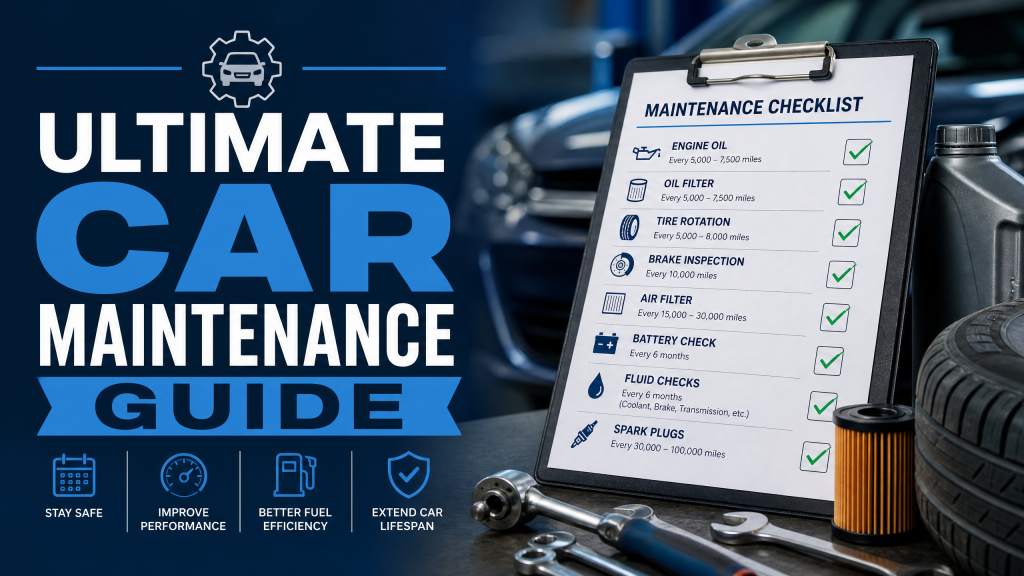
Engine oil lubricates thousands of metal components moving at high speeds, removes heat from critical engine areas, and carries contaminants away from precision surfaces. Over time, oil breaks down chemically and accumulates combustion byproducts that reduce its effectiveness. The interval at which you should change your oil depends on the type of oil used and your driving conditions. Vehicles using synthetic motor oil and driven primarily in normal conditions can typically go 7,500 to 10,000 miles or more between changes, per manufacturer specifications. Conventional oil users should generally change every 3,000 to 5,000 miles.
The old rule of “every 3,000 miles” has been outdated for modern synthetic-oil vehicles for over a decade, but some quick-change shops continue promoting it as it generates unnecessary service revenue. Always follow your vehicle’s actual owner’s manual recommendation rather than generic advice, as modern engines with full synthetic oil and oil life monitoring systems are engineered for extended intervals.
Tire Maintenance: Your Connection to the Road
Tires are the only component of your vehicle that contacts the road, making their maintenance directly relevant to both safety and fuel economy. Maintaining proper tire pressure, listed on the door jamb sticker rather than the tire sidewall, improves fuel economy by up to 3% and significantly extends tire life. Check pressure monthly and before long road trips. Tires naturally lose one to two PSI per month and additional pressure with temperature drops in fall and winter — for every 10°F decrease in ambient temperature, tire pressure drops approximately one PSI.
Tire rotation every 5,000 to 7,500 miles promotes even wear across all four tires, extending the set’s total life and preventing premature replacement of two tires while two others still have adequate tread. Wheel alignment should be checked annually or whenever you notice uneven tire wear or steering that pulls to one side. Proper alignment prevents premature tire wear and maintains fuel efficiency.
Brake System Maintenance
Brake maintenance is fundamentally a safety issue that should never be deferred once brake wear indicators begin making noise. Most modern vehicles use brake pad wear indicators that emit a high-pitched squealing sound when the pads wear to approximately 2mm remaining thickness, providing warning before brake performance is compromised. Once you hear this warning sound consistently, brake service should be scheduled within the next few weeks — not months.
Brake fluid absorbs moisture over time through the hygroscopic nature of most brake fluids (DOT 3 and DOT 4). Moisture contamination lowers the fluid’s boiling point, potentially causing brake fade during extended heavy braking. Many manufacturers recommend brake fluid replacement every two years regardless of mileage. This is particularly important in performance driving situations or in vehicles used for towing.
Air Filter Replacement
Your engine requires a precise mixture of air and fuel to combust properly. The engine air filter prevents dust, pollen, and debris from entering the engine, protecting precision internal components. A clogged air filter restricts airflow, reducing power and fuel economy. Engine air filters typically need replacement every 15,000 to 30,000 miles under normal conditions, though driving in dusty environments significantly shortens this interval.
The cabin air filter, which cleans air entering the passenger compartment through the HVAC system, should also be replaced regularly — typically every 15,000 to 25,000 miles or annually. A clogged cabin filter reduces HVAC system airflow and can contribute to musty odors inside the vehicle. Cabin air filter replacement is typically an inexpensive DIY task requiring only a few minutes.
Coolant System Maintenance
Engine coolant prevents the engine from overheating in summer and from freezing in winter, while also inhibiting internal corrosion. Modern extended-life coolants are designed to last 5 years or 150,000 miles in many applications, a significant improvement from older coolant formulations that required more frequent replacement. However, many vehicle owners neglect this service interval entirely, leading to coolant that has lost its corrosion inhibiting properties and can damage the water pump, radiator, and heater core.
At each oil change, visually inspect the coolant reservoir to verify it’s at the proper level and that the coolant appears green, orange, or pink — not brown or rusty. Discolored coolant is a sign of contamination or degradation that warrants immediate attention. Mixing different coolant types can cause chemical reactions that compromise protection.
Transmission Service
Transmission fluid lubricates the complex gear mechanisms inside both automatic and manual transmissions. Automatic transmission fluid degrades over time and through heat cycles, and neglecting this service is one of the most common causes of premature transmission failure — an expensive repair often costing $3,000 to $5,000 or more. Service intervals vary significantly by manufacturer, with some specifying transmission fluid replacement at 30,000 miles and others claiming “lifetime fluid” that technically never needs changing under normal conditions.
The “lifetime fluid” designation has proven controversial, as many mechanics report that vehicles with supposedly lifetime transmission fluid regularly experience transmission problems as they age. Many industry professionals recommend changing automatic transmission fluid every 60,000 to 90,000 miles regardless of manufacturer claims, viewing the modest cost of fluid replacement as inexpensive insurance against catastrophic transmission failure.
Battery Maintenance and Testing
Modern vehicles have become increasingly dependent on their electrical systems, making a healthy battery more important than ever. Car batteries typically last three to five years, though this varies with climate, driving patterns, and vehicle electrical loads. Signs of impending battery failure include slow engine cranking, dim headlights at idle, and the battery warning light illuminating. Most auto parts stores offer free battery testing, which can identify a weakening battery before it fails completely and leaves you stranded.
Preventive battery replacement based on age and performance testing is far less inconvenient and potentially dangerous than a dead battery at an inopportune moment. If your battery is over four years old and shows any signs of weakness, proactive replacement is a reasonable investment in reliability.
Following a consistent maintenance schedule that addresses these key systems will maximize your vehicle’s lifespan, maintain its resale value, and prevent the far more expensive repairs that result from neglecting routine service. The total annual cost of proper preventive maintenance is typically $500 to $800 for most vehicles — a small fraction of the repair bills that deferred maintenance eventually generates.
